
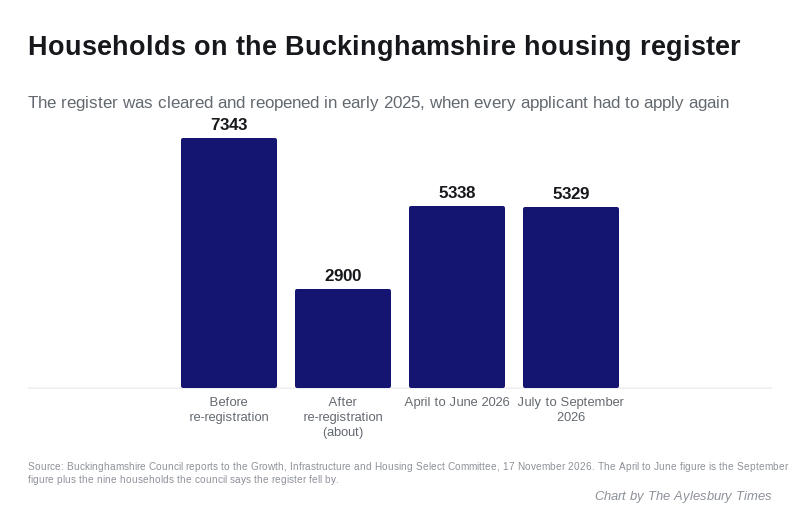
Buckinghamshire's social housing register has climbed back to 5,329 households. It fell to about 2,900 when every applicant had to re-register in 2025.
There are 5,329 households waiting on Buckinghamshire’s social housing register. That is 329 more than the council’s own forecast of 5,000, according to its performance report for July to September.
The figure has nearly doubled since early 2025. Then the council made every applicant on the register apply again under tighter rules, and the list fell from 7,343 households to about 2,900.
Both figures are in reports to the council’s Growth, Infrastructure and Housing Select Committee, which met on Tuesday 17 November.
Updated 19 November: waiting times by size of home and the shortage of family homes, from the data appendix published for the meeting.
What changed in 2025
The council’s report on the allocations policy says Cabinet approved new rules in October 2024. Every applicant then had to re-register between January and 10 March 2025.
The main changes were:
- applicants now need a five-year connection to Buckinghamshire, up from two years
- the old district lists were merged, so anyone can bid for homes across the whole county with the same priority
- the separate subgroups used in the Aylesbury Vale area were removed
- Fairhive, the Aylesbury housing association formerly called VAHT, stopped being a full partner in the scheme
- people aged 55 and over lost their exemption from the local connection rule
- more priority went to people fleeing domestic abuse, veterans, households served with a valid eviction notice and people the council owes a homelessness duty
- adult children aged 18 and over can now count as part of the household
Some groups are exempt from the five-year rule. They include households on government resettlement schemes, people owed certain homelessness duties and households in supported housing in the county. Households placed in Buckinghamshire by another council, for example in temporary accommodation, do not gain a local connection that way.
Why the list grew back
The council says the jump after the list reopened was expected. It blames “pent-up demand” built up during the re-registration, and says application numbers have now settled back to more typical levels.
The register fell by only nine households between the April to June quarter and the July to September quarter. The council is contacting applicants who are not bidding for homes so their records can be updated or closed.
Since 29 April 2026 every application has been reviewed automatically each year. The council says this clears dormant and expired accounts. Its own performance report asks councillors to tell apart “administrative reductions” from households who have actually found a home.
How long people wait for a home
A data appendix published for the committee shows how long households housed in March 2026 had waited. It counts every band together:
| Home | Lets in March 2026 | Shortest wait | Longest wait | Average wait |
|---|---|---|---|---|
| Sheltered housing | 14 | 10 weeks | 30 months | 11 months |
| 1-bed (general needs) | 20 | 10 weeks | 7 years | 15 months |
| 2-bed flat or maisonette | 15 | 5 months | 5 years | 15 months |
| 2-bed house | 22 | 13 weeks | 5 years | 19 months |
| 3-bed house | 20 | 9 weeks | 7 years | 27 months |
A second table in the appendix gives slightly different figures for one-bed homes (26 lets, average 14 months) and two-bed flats (16 lets, average 14 months). No four or five-bedroom homes were let that month. The appendix says 1,369 households are waiting for a home with three or more bedrooms, against 263 such homes becoming available.
It also says:
- 31.2% of lets went to homeless households and 22.1% to overcrowded households
- 307 households in temporary accommodation were rehoused through direct lets
- a homeless household spent an average of 212 nights in temporary accommodation in 2024/25
- 35.2% of households rehoused moved to another part of the county
The appendix names Aylesbury Vale as a higher-supply area, meeting local demand and taking households from elsewhere in the county. All of these figures are in the council’s data appendix. Its count of lets in each year is given the opposite way round in two places, so we have not used it.
Other housing figures in the report
The same performance report gives these figures for July to September:
- an average of 20 people sleeping rough, below its seasonal target of 30 but up from 16 in the previous quarter
- 55% of households in temporary accommodation were in longer-term units rather than nightly paid placements, against a target of 60%
- the average nightly paid placement now costs under £79
- no family with children spent more than six weeks in bed and breakfast accommodation with shared facilities
What it means for you
If you are on the register, the annual review means you must keep your application up to date. An account that is not being used to bid can now be closed.
If you have lived in Buckinghamshire for less than five years, you are unlikely to qualify unless one of the exemptions applies. Applications go through Bucks Home Choice, the council’s lettings scheme.
The committee took the item on Tuesday 17 November. Its minutes are not yet published; the meeting page links to the webcast.
Have your say